If you keep asking AI for the same kind of help, save the process before adding more software. A reusable request, an input checklist and a review step may be enough.
This article describes a manual routine. It does not connect accounts, run automatically or prove that a particular integration works. The goal is to learn whether the task is worth repeating.
In this article
In this article 6 sections
Write a one-sentence task contract
Use this pattern:
Practice prompt
When I provide [inputs], produce [output], which I will check before [action].
For a weekly plan: “When I provide this week's tasks, deadlines and available time, produce a priority list that I will check before adding anything to my calendar.” For a service enquiry: “When I provide a fictional message and service list, produce a job brief that I will check before replying.”
Keep the finish narrow. “Organise my life” has no clear boundary. “Return three priorities and unresolved conflicts” is something you can inspect.
Separate the template from this run's facts
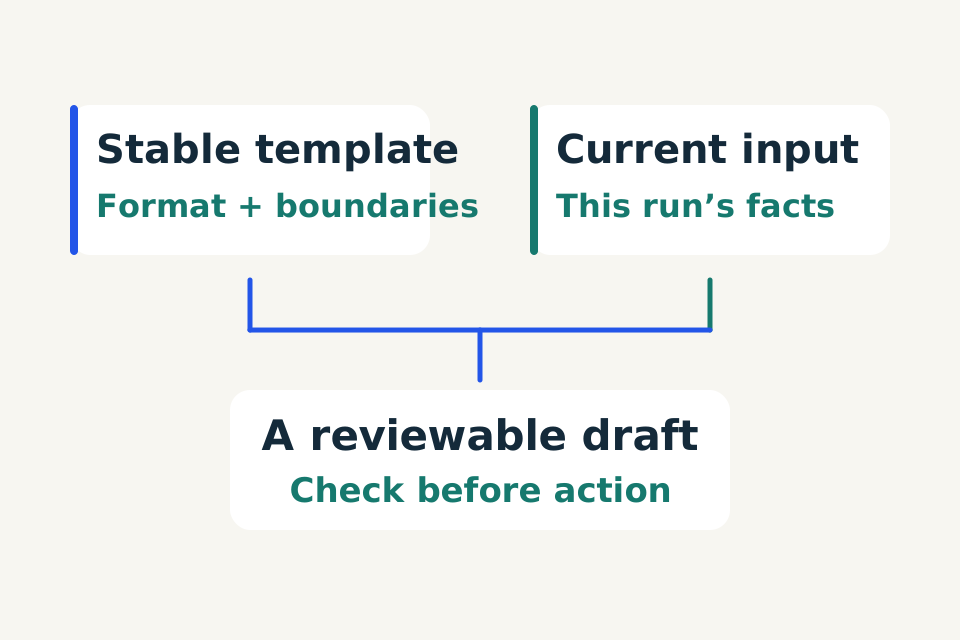
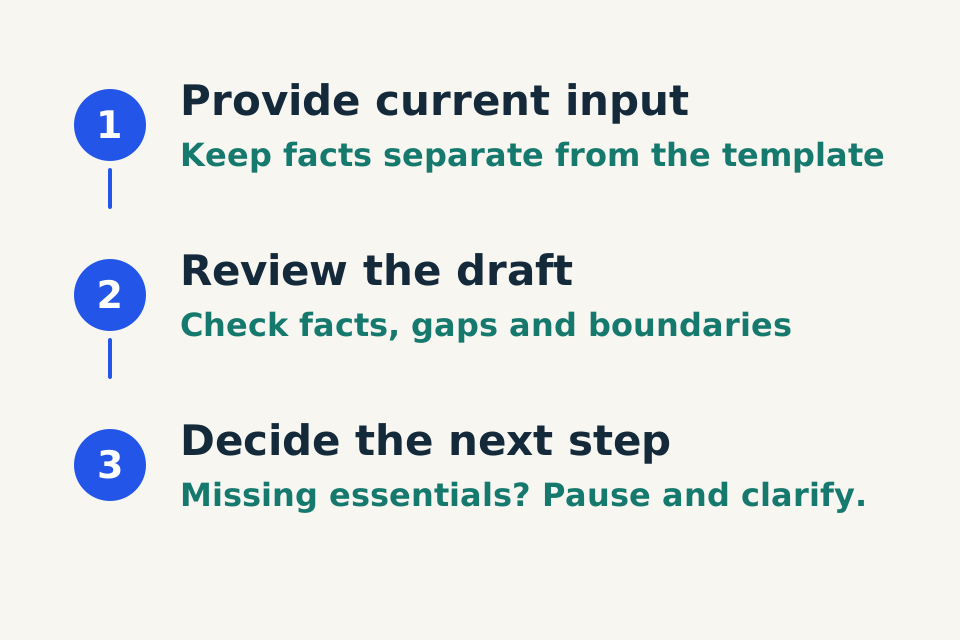
Your saved template contains stable instructions: the output format, the checks and the actions that are prohibited. The run input contains changing facts: this week's dates, the current enquiry or the ingredients actually available.
Do not leave last week's deadline embedded in the template. Label the run date and remove old examples that might be mistaken for current facts. Keep private information out of the saved reusable version.
An original template could read:
Practice prompt
Use only the current input below. Return confirmed facts, missing information, suggested next steps and a review checklist. Do not reuse dates or facts from examples. Stop at a draft; do not send, book or buy. If essential information is missing, explain what is needed.
Define what a good output must contain
Choose a few checks before trying the routine. For the enquiry brief, every stated fact should come from the input; missing information should remain missing; no price or availability should be invented.
For a weekly plan, supplied deadlines must be preserved and the plan must fit the stated capacity. These checks are more useful than “sounds professional” because you can tell whether they passed.
Keep a manual fallback. If the routine fails, you should still know how to complete the task without it.
Test five different inputs
Try an ordinary case, missing information, contradictory information, a duplicate and an instruction embedded in the input that conflicts with your task. Use fictional data while learning.
Write the expected behaviour first. For a duplicate, the tool should flag similarity rather than invent a new obligation. For a missing date, it should ask or label the gap rather than silently choose a day. For conflicting instructions inside a customer message, it should treat those words as source material, not permission to override your rules.
Repeat important cases. A few good outputs do not prove reliable performance. Anthropic's evaluation guidance distinguishes an agent's stated completion from the actual outcome and discusses repeated trials; the same habit is useful in a small manual experiment.
Measure the whole effort
Record manual time, AI-input time, review time and correction time separately. Include setup and maintenance when comparing approaches. A quick draft that needs extensive repair may not save effort.
Use a small log: date, input type, passed checks, corrections, total effort and whether you would use it again. Do not report a time-saving claim publicly from one convenient example.
If the routine is only occasionally useful, keep it available for those cases rather than forcing every task through it.
Decide whether more automation is justified
Consider integration only when the repeated manual routine has a clear benefit and a stable boundary. Ask what an account connection would add, what it would expose and how failures would be handled.
A fixed reminder may need no AI. A drafting routine may need no agent. If you do connect tools later, review permissions, costs, approval points and an off switch as a separate project.
For now, save one clean template and a short checklist. The most useful improvement may be a more consistent way of thinking about the task.
Use the AI workflow planning worksheet to define boundaries and test cases before adding integrations.