An AI answer can be clear, helpful and wrong. The practical question is which parts you need to verify before using it. A draft birthday message needs a different level of checking from a statement about a deadline or a purchase.
NIST identifies confidently presented false content as a risk of generative AI. A polished answer should therefore be treated as a starting point, not proof.
In this article
In this article 6 sections
Separate the answer into claim types
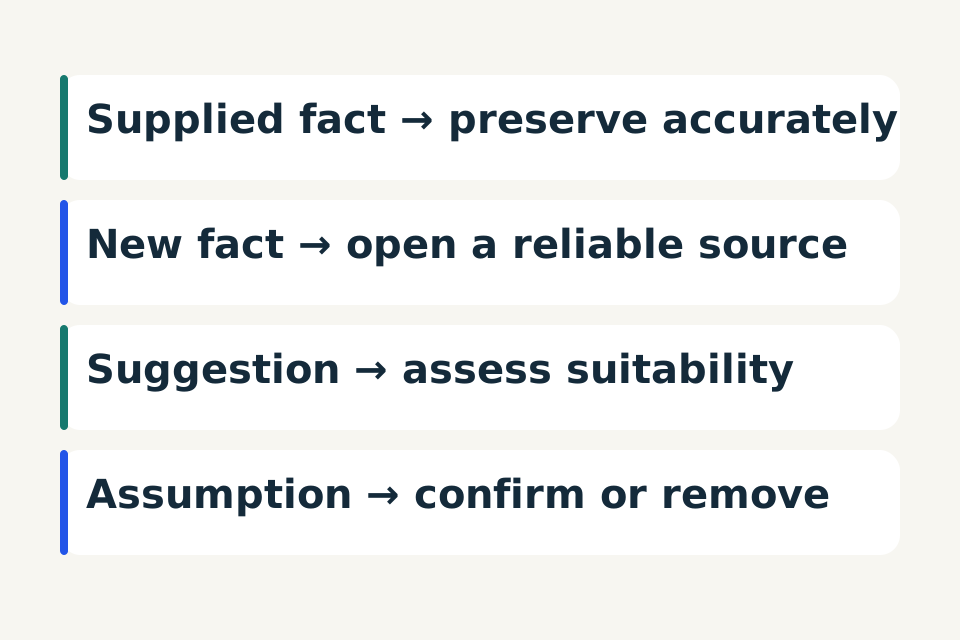
Mark each important statement as one of four things: a fact you supplied, a new factual claim, a suggestion or an assumption. They need different checks.
If you supplied “the appointment is Thursday,” the tool should preserve Thursday. If it adds “the office closes at 4,” that is a new claim requiring a current source. “Leave early” is a suggestion. “You will drive there” is an assumption unless you said so.
This distinction prevents a common problem: a useful suggestion quietly becoming an invented fact. Ask for a short list of assumptions when the answer mixes them together.
Use a fictional outing to practise
Imagine an answer says: “Visit Harbour Museum on Sunday. It opens at 9, entry is $12 and parking is free.” This museum and these details are invented for the exercise; they are not travel advice or an observed AI failure.
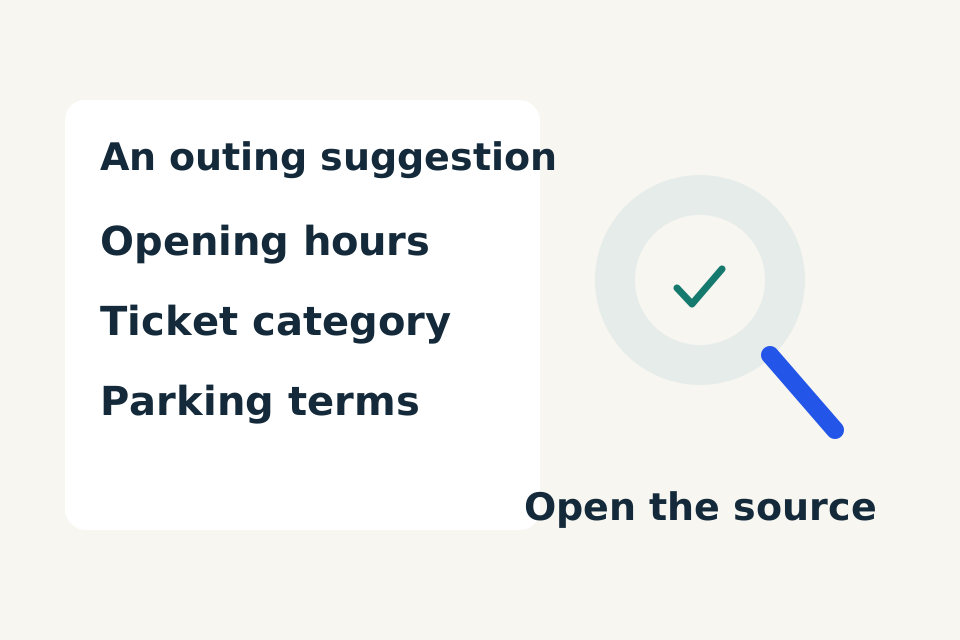
There are at least three independent claims to check. Open the real venue's official page for the actual outing you are planning. Look for the date or season covered by its hours, the correct ticket category and parking conditions. A search preview from last year is insufficient if the venue has seasonal opening times.
Write the result in plain language: “Sunday hours verified; ticket price verified for adults; parking cost not found.” Leaving one item unknown is more honest than treating the whole answer as confirmed.
Open the source and match the claim
A link can point to a real page without supporting the sentence next to it. Check the relevant passage, who published it, when it applies and whether it concerns your exact location, model or situation.
For product specifications, prefer the manufacturer. For an official application deadline, use the responsible agency. For a venue, use its current booking or information page. Where a consequence is significant, obtain the appropriate professional guidance rather than asking a chatbot to settle it.
Do not assume two websites provide independent confirmation if both copied the same original claim. When sources conflict, keep the disagreement visible and check the more authoritative or current source.
Recalculate numbers separately
An answer can use the right inputs and still produce the wrong total. Recalculate quantities, dates and arithmetic with a calculator or spreadsheet you can inspect.
For example, a fictional purchase with a $40 item and $8 delivery is $48 before any applicable tax or other charge. If the answer says $45, ask where the difference came from. Do not let a plausible explanation replace checking the actual checkout.
Units matter too: monthly versus annual, centimetres versus inches, per person versus per booking. Write the unit beside the number while reviewing it.
Ask for uncertainty without outsourcing judgement
Useful follow-ups include:
Review prompt
Which statements depend on current information? Separate what the source explicitly says from your interpretation. Mark anything you cannot verify.
Review prompt
What missing detail could change this answer? Do not fill it in for me.
These requests help expose weaknesses, but the tool's own review is still not an independent check. A second AI agreeing is not the same as a primary source supporting the claim.
Decide what is safe to use
Keep verified facts, adapt useful suggestions and remove unsupported promises. If an essential fact remains unknown, pause the affected action. You can still complete unrelated parts of the task.
Save a short note of the source and check date for information you will reuse. Recheck changeable details when you actually act. The aim is not to investigate every harmless sentence; it is to put effort where an error would matter.
Keep the Ask, Improve, Check worksheet beside your next chat as a review reminder.