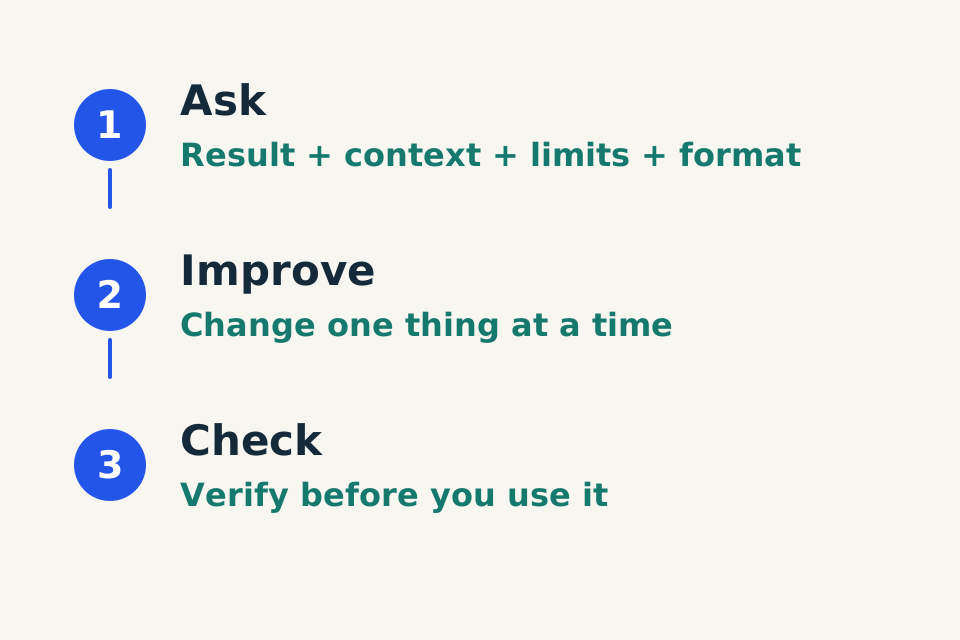
Use this card beside an AI chat. It is a working tool for an ordinary task you can check, not a list of magic prompts. Fill the fields in your own notes, then share only the information the task needs.
The examples are fictional. No account connection, purchase or paid tool is required to complete the worksheet.
In this guide
In this guide 6 sections
Before you start
Choose a task with a clear, low-risk result. Examples include arranging a list, comparing supplied specifications or drafting a routine reply. Keep important medical, legal and financial decisions with appropriate professionals.
Write these three answers:
- My task is: ______
- A useful result would look like: ______
- Before acting, I will personally check: ______
If you cannot describe a useful result, make the task smaller. “Help with dinner” becomes “suggest three meal ideas using this ingredient list.” “Sort my business” becomes “extract missing details from this fictional enquiry.”
Step one: ask clearly
Complete this request:
Practice prompt
Help me produce ______. Use only this relevant information: ______. Keep these limits: ______. Return the answer as ______. Flag missing facts and assumptions. Do not ______.
Keep the input separate from the instructions. For example:
Practice prompt
Organise the fictional tasks below into fixed deadlines, flexible tasks and tasks that can wait. Preserve the dates. Show anything that will not fit the available time. Do not create calendar events. Input: return books Tuesday; complete a form Thursday; tidy one cupboard sometime. Available time: Monday 30 minutes, Wednesday 60 minutes.
Read the request once before sending it. Remove unnecessary names, addresses, private records and any secret credentials. If it contains conflicting requirements, decide which one matters most.
Step two: improve one thing
Choose the main problem with the first answer. Use one of these follow-ups and add specifics:
- Too broad: “Limit this to ______. Leave ______ for later.”
- Too long: “Keep ______ and reduce the answer to ______.”
- Missing facts: “Mark ______ as unknown. Do not infer it.”
- Wrong priority: “Treat ______ as a requirement and ______ as optional.”
- Changed circumstances: “Replace ______ with ______ and show what else changes.”
For the task-list example, try: “Wednesday is unavailable. Keep the deadlines unchanged and identify what needs another plan.” Check whether the revision exposes the problem rather than inventing time.
Do not keep revising simply because another version is possible. Stop when the output meets the task's requirements.
Step three: check before acting
Use this checklist on the final answer:
Review checklist
- The dates, quantities and limits I supplied are unchanged.
- New factual claims are supported by appropriate sources where needed.
- Current prices, opening hours or availability have been checked separately.
- Calculations and units have been independently checked.
- Missing information remains visible.
- No price, booking, deadline or other commitment has been invented.
- The output does not disclose information I intended to keep private.
- I know what still needs a human decision.
Asking AI to check itself can reveal issues, but it does not replace looking at the relevant evidence. Open a source and read the part that supports the claim.

The diagram in words
- Verify supplied dates, quantities and limits against your notes.
- Check new factual claims at an appropriate original source.
- Independently check calculations and units.
- Keep invented commitments out and retain the final human decision.
Keep a tiny result log
Write: task, what helped, what needed correction and whether you would use the method again. Include the effort of reviewing and fixing, not just generating the answer.
Example: “Weekly list. Helped separate deadlines from optional tasks. Needed correction because travel time was missing. Reuse after adding travel constraints.” This is a fictional log entry, not a measured result.
Save a clean version
Keep the reusable instructions and remove the run's personal details and expired dates. Next time, supply fresh inputs. If the same task works well repeatedly, use the First Useful AI Workflow guide to define a fuller routine.
Your finish line is simple: one reviewed result, one decision you keep and one useful lesson for next time.
For a longer practice sequence, try the seven-day beginner workbook.