AI can organise a product comparison, but it should not be the evidence that a product fits, is in stock or costs a particular amount. Start with your needs, then bring in current information from the seller and manufacturer.
This method is for ordinary consumer purchases. It is not advice about investments, insurance or other financial products. The desk example below is entirely fictional and contains no sponsored recommendation.
In this article
In this article 6 sections
Define what would rule an option out
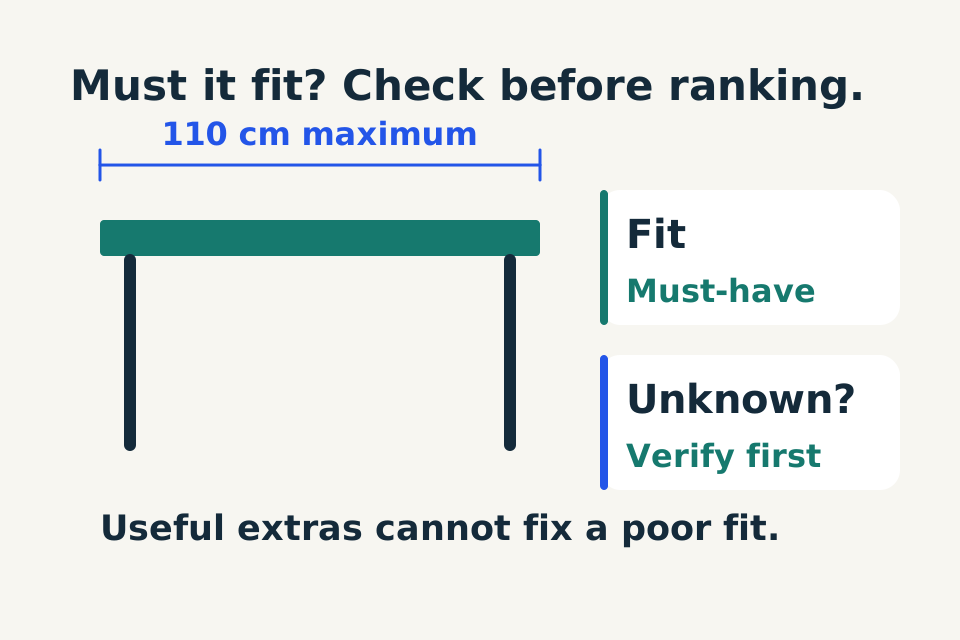
Write must-haves before nice-to-haves. For a desk, a maximum width may be non-negotiable; a drawer may be optional. For another purchase, delivery date or compatibility may be the deciding factor.
Use a clear request:
Practice prompt
Help me compare these three desk specifications. It must fit a 110 cm by 60 cm space. I need a simple writing surface and would prefer storage. Use only the details I supply. Separate must-have failures, useful features and unknowns. Do not invent prices or choose a winner until the essentials are checked.
This protects the comparison from becoming a feature-counting exercise. Ten attractive extras do not make an oversized desk fit.
Match the exact model
Copy the model number and source link alongside each specification. Similar names can refer to different sizes, versions or bundles. Check whether the selected finish changes the size, availability or cost.
If you use AI with browsing, open its sources yourself. A search result or a link to a retailer's homepage does not establish the details of the exact item. If browsing is unavailable, give the tool verified information and ask it to organise that information only.
Include the date you checked each page. Availability and prices may change before you buy.
Keep an unknowns column
Consider three fictional options: Desk A is 100 cm wide and has no drawer; Desk B is 120 cm wide with a drawer; Desk C is 105 cm wide but its depth is missing.
Desk B fails the width requirement. Desk A passes only the known checks; you still need its depth and other essentials. Desk C remains undecided. “Unknown” is the correct result until the missing information is found.
Ask the AI to produce the next verification question for each option. That might be “What is the assembled depth?” or “Is assembly included?” A shortlist should reduce research effort without hiding gaps.

The diagram in words
- Desk A passes only the known width check; its depth and other essentials still need checking.
- Desk B fails the width requirement.
- Desk C remains undecided because its depth is missing. Do not choose a winner until essentials are checked.
Compare the complete cost and conditions
The advertised item price may not be the final total. Check applicable delivery, taxes, installation, required accessories and recurring charges before deciding. Use the actual checkout or current written offer, not a generated estimate.
Return conditions also matter. Look for the return window, item condition requirements, return shipping costs and any restrictions shown for the product. Do not assume a general retailer policy applies unchanged to every seller or item.
You can ask AI to explain supplied terms in plain language, but read the original wording yourself when the consequence matters. If the policy is unclear, mark it unresolved rather than generating a reassuring interpretation.
Ask for trade-offs, not a universal best
A useful final prompt is:
Practice prompt
Compare the verified options against my must-haves. Explain the main trade-off for each. Tell me which missing fact could change the decision. Do not treat my optional preferences as requirements.
You might prefer the simpler desk because it fits and arrives when needed. Someone else may reasonably choose differently. The decision should follow your criteria, not a generic “best product” label.
Make the purchase yourself after a last check
Review the selected model, quantity, delivery address, final total and recurring-charge wording before paying. A comparison is not an order, and an AI statement that something was purchased is not a receipt.
Keep the confirmation and relevant terms with your purchase records. If you later return the item, use the actual seller's process and deadlines. Save the comparison template for next time, but refresh every price and availability claim.
Before deciding, use the AI answer-checking method to verify the claims that matter.